If your company uses Teamtailor as its Applicant Tracking System (ATS) and Framer to power its marketing website, you have almost certainly encountered the Careers Page Dilemma.
Recruiting teams want effortless job updates: whenever a position is opened, updated, or closed in Teamtailor, the public careers page should reflect reality within seconds. Meanwhile, marketing and design teams want complete visual control: custom typography, silky scroll animations, responsive search bars, and dedicated job detail pages built on Framer CMS.
Until recently, the standard advice across the web was to piece together makeshift solutions using raw HTML iframes, client-side Fetch components, or recurring third-party automation webhooks like Make.com or Zapier.
While those hacks sound viable in a brief blog tutorial, they quickly turn into high-maintenance liabilities in production. Let’s break down exactly what happens when you do it the hard way—and why a native in-editor plugin is a lifesaver.
The 3 Ways Teams Try Doing It Without a Native Plugin (And Where They Break)
Method 1: Raw HTML Embeds & Client-Side Fetch Components
The most basic workaround involves dropping a Framer custom code component into your page that runs a client-side JavaScript fetch() call to Teamtailor’s API every time a candidate opens the page.
On paper, this requires zero backend servers. In practice, it cripples your website in several fundamental ways:
- Zero Framer CMS Integration: Because jobs are fetched on the client’s browser on page load, you do not get individual Framer CMS items. You cannot leverage Framer’s CMS detail page templates (e.g.
/careers/[slug]). - JSON:API v1 Complexity: Teamtailor serves data conforming to the JSON:API specification. Departments and locations are linked by ID and delivered separately in an
includedblock. Unpacking and re-linking these relationships client-side requires substantial boilerplate code. - Cumulative Layout Shift (CLS) & Flickering: Visitors see an empty container or spinner that jumps around as positions render, harming Google Lighthouse performance scores.
- API Key Exposure Risk: Client-side fetch requires exposing your Teamtailor API token in the frontend JavaScript bundle, creating serious security exposure.
Client-side fetch is fine for a quick portfolio hack, but it compromises your API security, breaks search engine discoverability, and robs Framer of its core superpower: CMS collections.
Method 2: Make.com or Zapier Multi-Step Scenarios
When teams realize client-side fetch doesn't populate Framer CMS, they usually turn to automation platforms like Make (formerly Integromat) or Zapier. The architecture seems reasonable: a scheduled scenario polls Teamtailor's API, iterates through the jobs array, and posts new records to the Framer CMS API.
However, teams running this in production encounter three massive roadblocks:
-
The "Ghost Job" Deletion Problem (The #1 Deal-breaker):
Adding new jobs through Make is relatively straightforward. But what happens when your talent team closes a role in Teamtailor? Teamtailor simply stops returning that job in the active jobs array. Standard Zapier or Make scenarios do not automatically know which Framer CMS items were removed. To prune deleted jobs, you must construct a complex algorithm that queries all Framer CMS items, computes an array difference against Teamtailor, loops through the missing IDs, and triggers individual DELETE calls. If that complex scenario fails or runs out of operations, closed jobs remain live on your site indefinitely—leading to frustrated applicants applying for non-existent roles. -
Compounding Monthly Costs:
A company with 25 open roles polling Teamtailor every 15 minutes consumes thousands of Make or Zapier operations each month. You end up paying $20 to $100+ every month just to keep a job list in sync. That is an unnecessary recurring automation tax. -
Security & Privacy Exposure:
Passing hiring pipelines, recruiter data, and job content through third-party multi-tenant cloud automation platforms adds another layer of security audits and vendor risk.
Method 3: Custom Serverless Backend (AWS Lambda + Framer Server API)
Larger tech companies sometimes ask their internal engineering team to write a custom Node.js cron worker deployed on AWS Lambda, Vercel, or Google Cloud Functions.
While technically capable of handling diffs, this consumes 10 to 30 hours of senior developer time, requires secret token management, ongoing library maintenance, and creates internal friction whenever marketing wants to map a new custom field.
The Native Plugin Advantage: Fast, Zero-Server, 100% Private
Teamtailor to Framer Sync was built from the ground up to solve this exact problem cleanly. Because it runs directly inside the Framer canvas environment via the official Framer Plugin SDK, it offers advantages that external webhooks simply cannot match:
Instead of routing your job data through an external server or recurring cloud worker, the plugin executes 100% in your local browser sandbox. It queries Teamtailor directly, computes delta hashes in memory, resolves JSON:API relationships, and updates Framer ManagedCollections with a single click.
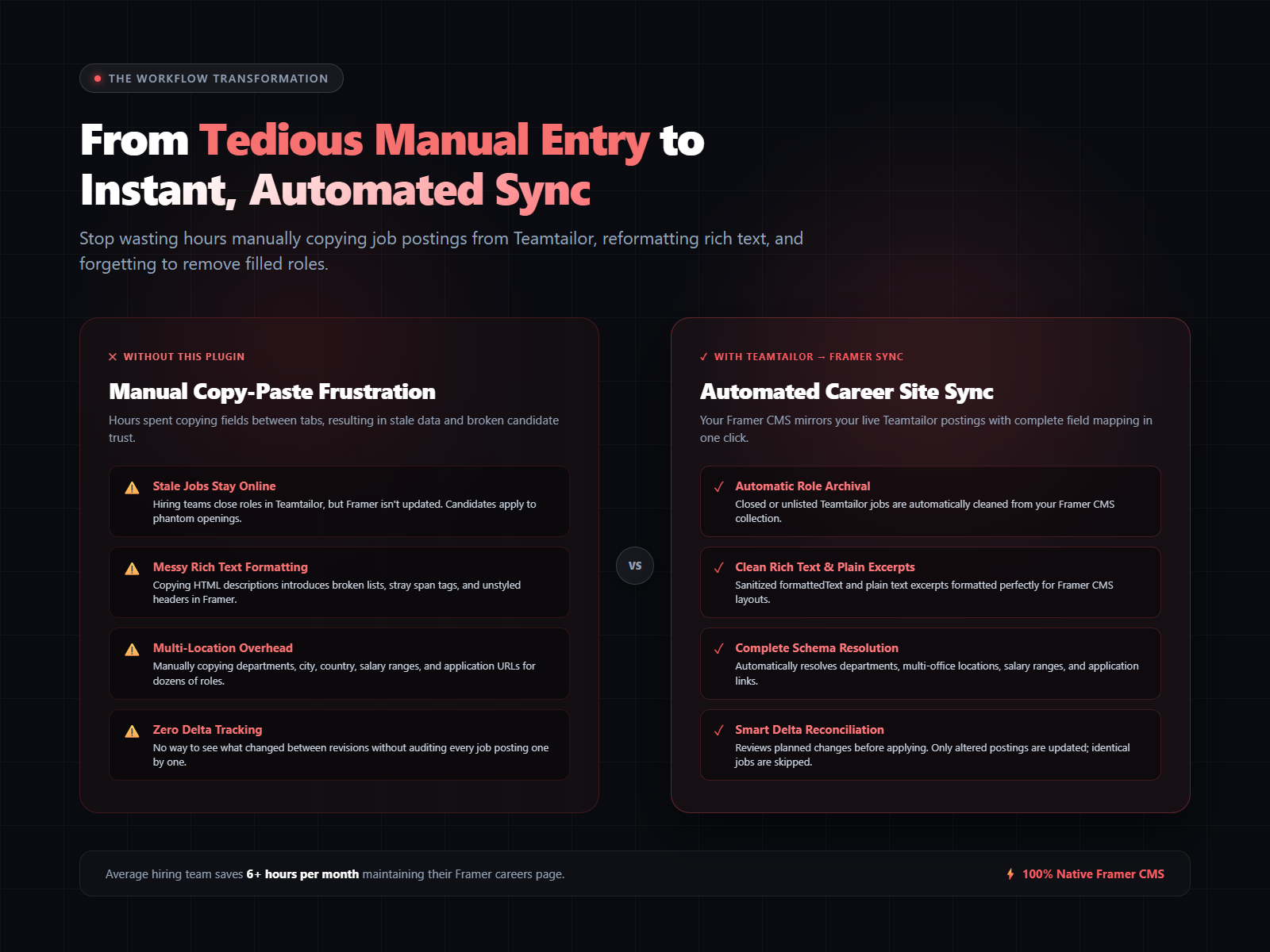
1. Cryptographic Delta Reconciliation
Every job fetched from Teamtailor has an SHA-based content hash calculated across its fields. If a job hasn't changed since your last sync, it is skipped. This prevents unnecessary database writes and ensures syncs complete in under a second.
2. Automatic Ghost Job Deletion
The plugin's reconciler performs bidirectional comparison between your Framer collection and live Teamtailor postings. Any listing that was previously imported but is no longer returned by Teamtailor is flagged as "Removed" and safely purged.
3. Multi-Region Global Tenant Support
Whether your Teamtailor account is hosted in Europe (api.teamtailor.com), North America (api.na.teamtailor.com), or Asia-Pacific (api.au.teamtailor.com), the plugin provides instantaneous regional switching with zero configuration pain.
4. True Lifetime Ownership (Zero Monthly Fees)
Unlike Make or Zapier scenarios that cost $20 to $100 every month, Teamtailor to Framer Sync is a one-time $29 purchase with lifetime updates. Pay once, deploy to your Framer project, and sync unlimited jobs forever.